
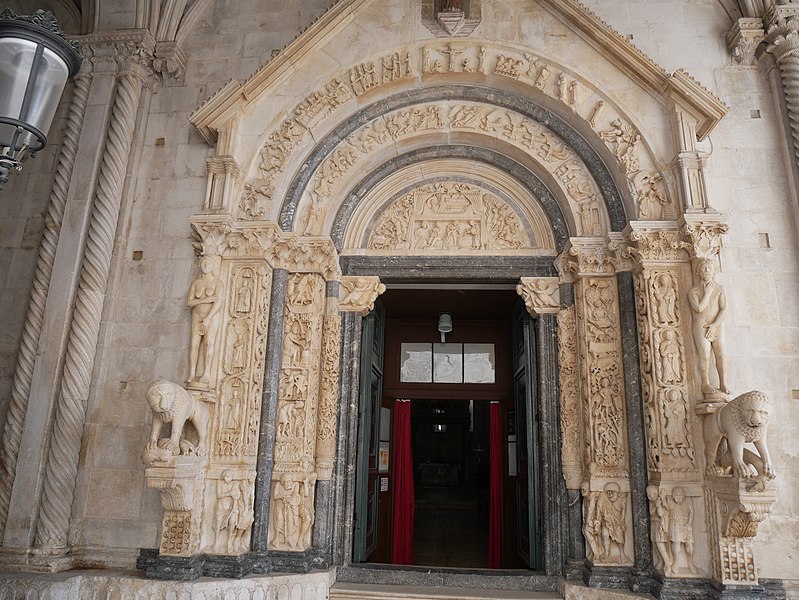
Trogir, Croatia
Take a sightseeing stop in Trogir during your private car transfer!




Sightseeing stop in Trogir: discover beautiful places in CroatiaTrogir highlighthistorical center is a UNESCO World Heritage Site We at Monterrasol Transfers specialize in private car transfers. Together with the transfer itself, we propose that you visit some beautiful places along the transfer route. We call such places optional sightseeing stops (short excursions). One of the places we selected to propose as a sightseeing stop is a beautiful Trogir in Croatia. Sightseeing stops are a perfect easy opportunity to see new places during your transfer across Croatia, especially during long distance transfers. Take it as a great option to get in touch with local culture and history. It's good to combine transportation and sightseeing together! Trogir is a historic harbour town on the Adriatic coast of Croatia, in Dalmatia region, one of the four historical regions of Croatia. Since 1997, the historic center of Trogir has been included in the UNESCO list of World Heritage Sites for its Venetian architecture. Last reviewed: 26 May 2026 Trogir descriptionTrogir is a historic harbour town situated on the Adriatic coast in the Split-Dalmatia County of Croatia. The remarkable settlement is built on a tiny island squeezed between the Croatian mainland and the larger island of Ciovo. It lies approximately 27 kilometres west of the popular city of Split, making it an easily accessible destination. The town's name has ancient origins dating back over two millennia. It was founded in the 3rd century BC as Tragurion by Greek colonists from the island of Vis. The name is derived from the Greek words "tragos" (meaning male goat) and "oros" (meaning hill or mountain). The name might also derive from the Illyrian word "Tregur" (Three Stones). During the Roman period, the town was known as Tragurium, while the Venetians later called it Trau. The sudden prosperity of close located town Salona deprived Trogir of its importance. During the migration of Croats the citizens of the destroyed Salona escaped to Trogir. Initially the Roman Tragurium was one of the Dalmatian City-States. From the 9th century on, Trogir paid tribute to Croatian rulers and to the Byzantine empire. In the year 1000 the Republic of Venice received submission from the Tragurium inhabitants and the city started since then to have commerce with the Italian peninsula enjoying cultural and economic improvements. In 1123 Trogir was conquered and almost completely demolished by the Saracens. However, Trogir recovered in a short period to experience powerful economic prosperity in the 12th and the 13th centuries, with some autonomy under Venetian leadership. In 1242 King Bela IV of Hungary found refuge there as he fled the Mongols. In 1420 the period of a long-term Venetian rule began and lasted nearly four centuries, when Trau (as the city was called by the Venetians) was one of the best cities in the Balkans with a rich economy and plenty of Renaissance works of art and architecture. On the fall of Venice in 1797, Trogir became a part of the Habsburg Empire, which ruled over the city until 1918, with the exception of Napoleon Bonaparte's French rule from 1806 to 1814 (when the city was part of the Napoleonic Kingdom of Italy and Illyrian Provinces). After World War I, Trogir, together with most parts of Dalmatia, became a part of the State of Slovenes, Croats and Serbs and subsequently, the Kingdom of Yugoslavia. During this period Italian speakers, who until 1918 were the present in the city left for Italy. 1939 it become a part of Banovina of Croatia. During World War II, Trogir was annexed by Italy and was part of the Italian Governorate of Dalmatia from 1941-1943. After short partisan rule it became part of Independent State of Croatia under German military supervision from 1943-44. Subsequently, Tito's Partisans liberated it in for second time 1944. After that it belonged to the second Yugoslavia, and since 1991 to Croatia. Trogir boasts an impressive 2,300 years of continuous urban tradition, making it one of the oldest settlements on the Adriatic. Its rich culture was shaped by the ancient Greeks, Romans, Byzantines, and Venetians, each leaving a distinct mark on the city's architecture. The historic core is so well preserved that it has been described as the best-preserved Romanesque-Gothic complex in all of Central Europe. The historic centre of Trogir was inscribed on the UNESCO World Heritage List in 1997. It was nominated as a cultural property under UNESCO criteria (ii) and (iv), which recognise the interchange of human values and an outstanding example of a type of building or architectural ensemble. The protected property covers 6.4 hectares, with an additional 4.8-hectare buffer zone. UNESCO praised the settlement's Hellenistic street plan and its fine public, domestic, and religious buildings. The orthogonal street plan of Trogir dates back to the Hellenistic period, demonstrating the lasting influence of its Greek founders. The entire historic town is enclosed within medieval walls and includes a preserved castle and tower. Because the settlement is contained on a small island, everything is within easy walking distance, allowing visitors to explore the entire core comfortably in a few hours. Trogir's grandest building is the Cathedral of St. Lawrence (known locally as Sv. Lovro), a magnificent structure that showcases a blend of Romanesque and Gothic styles. The cathedral's main west portal is a true masterpiece, carved by the renowned medieval artist Radovan and considered the most significant work of the Romanesque-Gothic style in Croatia. This portal is a highlight for any visitor interested in art and history. The portal, executed by Master Radovan in the 13th century, is adorned with intricate sculptures depicting biblical scenes and figures. It stands as a testament to the exceptional artistic skill that flourished in Trogir during the medieval period. For art lovers, studying the detailed carvings on this portal is an unforgettable experience. At the western tip of the island stands the Kamerlengo Fortress, a large and impressive Venetian fortification. It was built in the 15th century to protect the town from Ottoman invasions and naval attacks. Today, the fortress is open to the public, and visitors can climb its walls for spectacular panoramic views over the sea and the red rooftops of the old town. Trogir's main square is dominated by the elegant Town Loggia, a covered public space once used for judicial ceremonies and public gatherings. Next to it stands the Duke's Palace (Knezeva Palača), a building that housed the Venetian governor. These structures, with their distinctive Venetian Gothic architecture, form the civic heart of the old town. One of the finest examples of Venetian Gothic architecture in Trogir is the Cipiko Palace, located directly across from the cathedral. This beautifully preserved 15th-century palace features an ornate facade with delicate stone tracery and arched windows. It now houses the town's administrative offices but remains a stunning example of the wealth and taste of Trogir's noble families. The medieval fortifications that surround the historic island are remarkably well preserved. Visitors can walk along sections of the walls and pass through the ancient city gates. The North Gate, dating from the 17th century, features a relief of St. John of Trogir, while the Sea Gate is adorned with the Venetian lion symbol, a reminder of the Republic's long rule. Trogir holds a fascinating piece of European history: it claims to have had the first public pharmacy on the continent, which opened in 1271. This fact highlights the town's historical importance as a centre of learning and commerce. The Benedictine monastery of St. Nicholas also houses a collection of ancient artefacts, including the famous relief of Kairos, the Greek god of opportunity. The Riva, Trogir's palm-lined waterfront promenade, is a lively and picturesque place to enjoy a coffee or a meal. From here, visitors can watch yachts and fishing boats glide through the channel that separates Trogir from the island of Ciovo. The views of the old town's bell tower and fortress reflected in the water are particularly stunning at sunset. The Cathedral Treasury houses a rich collection of religious art, including paintings, gold artefacts, manuscripts, and reliquaries spanning several centuries. The Museum of Sacred Art is located in the former Bishop's Palace and displays valuable liturgical objects and artworks. The City Museum of Trogir, situated in the Garagnin-Fanfogna Palace, offers exhibits on local history, archaeology, and the daily life of Trogir's noble families through the ages. Trogir enjoys a Mediterranean climate characterised by hot, dry summers and mild, wet winters. July and August are the warmest months, with average high temperatures reaching 27-28°C (81-82°F) and low humidity. January is the coldest month, with average highs around 9°C (48°F). The town receives significant rainfall, with November being the wettest month (189 mm) and July the driest (19 mm). The sea is warmest in July and August, reaching a pleasant 24°C (75°F). The best time to visit for sightseeing and swimming is from June to September, when sunshine is abundant and temperatures are comfortable. Tourists are drawn to Trogir because it offers a compact, walkable, and incredibly well-preserved slice of European history. It is often nicknamed "little Dubrovnik" for its stunning Venetian architecture, but it is generally less crowded and more affordable. The combination of a dramatic 2,300-year history, a UNESCO World Heritage core, beautiful coastal scenery, and easy access from the nearby Split Airport makes it an ideal day trip or a relaxing base for exploring the Dalmatian coast. We know good things to see in Croatia. We know the roads, well-known tourist attractions like UNESCO sites, and off-the-beaten-path places. If you would like to learn more about Croatia and explore it by visiting different attractions, come with us for a private tour. We can travel all across Croatia and we will show you all the important tourist attractions together with the hidden gems of this beautiful country. Feel free to contact us! We have developed numerous itineraries for private car tours in Croatia as well as in neighboring countries, including tours passing through several countries as one journey. Solo private tours and tours for Seniors are available also. Transfers to TrogirCurrently we know prices for these car transfers to Trogir: Private transfers from Bosnia-HerzegovinaPrivate transfers from CroatiaUnable to find your transfer? If the transfer you need not exist in the list of our transfers, feel free to ask us for custom transfer by this form: ask for a custom private transfer to Trogir, Croatia. |
Safe TravelsThe Safe Travels stamp allows travelers to recognize destination companies around the world that have implemented health and hygiene protocols that are aligned with Global Safe Travels Protocols from World Travel & Tourism Council. Monterrasol Transfers has implemented health and hygiene protocols. Monterrasol Transfers is the Safe Travels company.  |
Follow us on:
Site version: 1.3 Clean focus (13-May-2024 update) on
© copyright Monterrasol Transfers team